November 12th- December 16th, 2025
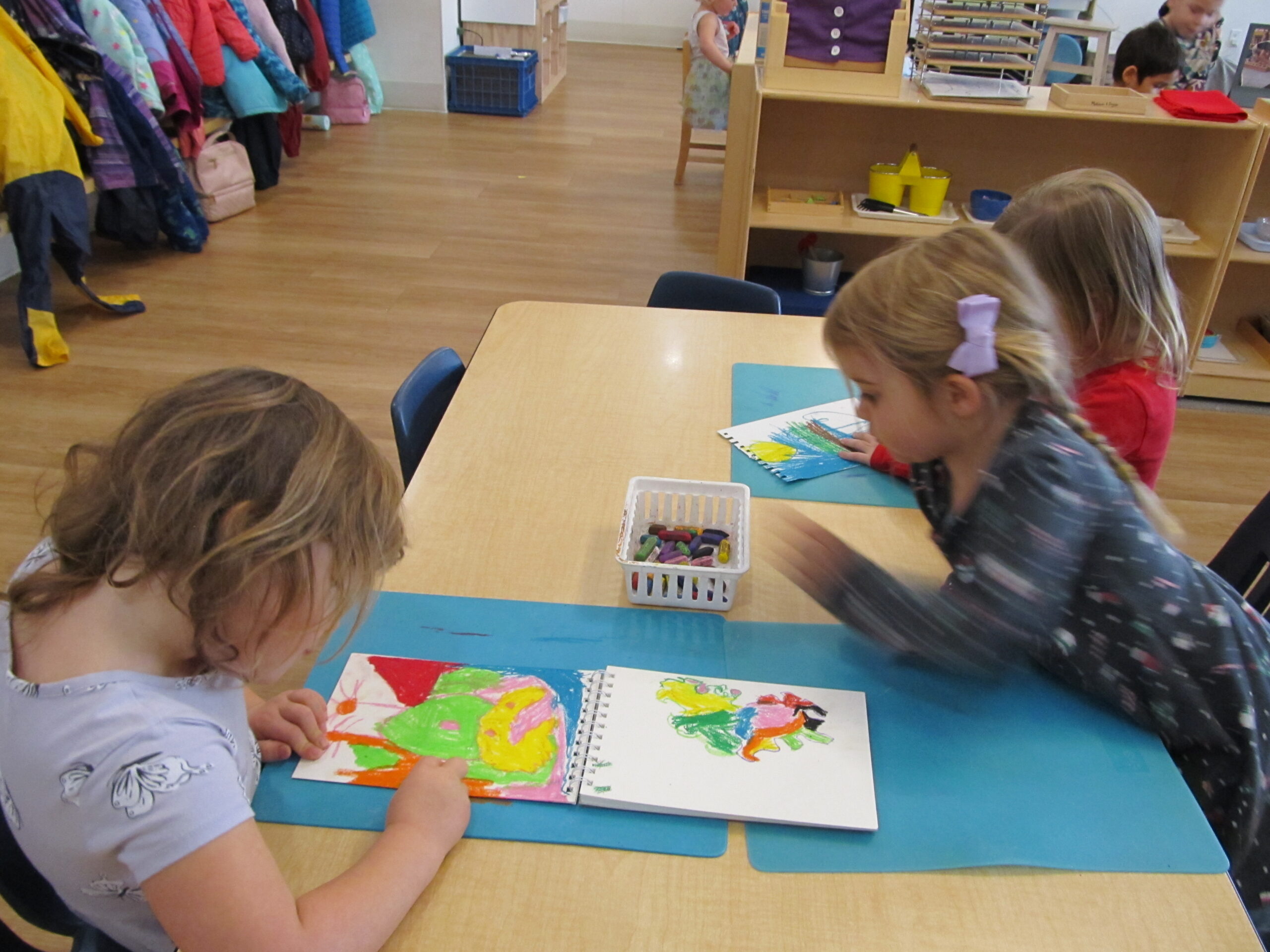
During my first couple of days of practicum, I sat with a few children and had them colour in my sketchbook. One child drew what she called a rainbow ghost. The rainbow ghost has eyes but no mouth and no feet, so he floats around. My mentor-teacher asked, “What does a ghost sound like when they’re moving?” One child suggested they don’t sound like anything. Another child responded with a gesture. This was the first time I had tried drawing with the children to explore and see what I could bring to them, and how to connect better in future drawing projects. Another day, a child drew a bee, and I got a bit of a conversation from it.
video-0914Educator: Can you tell me more about your bee?
A: Bees just get honey.
Educator: They get honey?
A: Yeah.
Educator: And you said that was a queen bee that you drew?
A: Yeah!
Educator: She’s the boss of the hive?
A: Yeah!
Educator: Did you see a bee outside today?
A: Yeah.
Educator: Yeah?
A: Bees sting us with their stingers, and they’re back.
Educator: Yeah, they do. Have you been stung by a bee before?
At: Nope.
T: I did, but it didn’t even hurt
A: I got stung by a bee right here one day. points
Educator: Oh, wow. What’s up, F?
F: When I was a baby, I got stung by a wasp in between my fingers.
Educator: Oh yeah, wasps are a lot worse than bees, aren’t they?
T: Yeah, they give us bites.
Educator: Wasps don’t do the same things as honey bees.
T: Spiders are good because they eat wasps.
Educator: They do eat wasps.
A: I never heard caffie. I never heard of caffies.
Educator: Caffies? What are those?
At: Is that a tarantula one?
Educator: It’s not a tarantula, but it is a spider
T: What… what are these?
Educator: Those are his eyes
T: Why so many eyes?
Educator: They do normally. They have four eyes… I think. From what I remember, it’s got four eyes. And it’s got little teeth, like fangs.
T: They’re chompers!
Educator: They are chompers!
*inaudible*
T: Can you write spider right there on it, and you can draw a tarantula on the other side?
Educator: I don’t know how a tarantula looks exactly. I just know how spiders generally look.
I could’ve (and should’ve) taken this conversation further. This conversation could have gone into how do spiders look? do all spiders look the same? can you draw me how you think a spider looks? where do spiders live? how do spiders move? etc. I didn’t realize at the time what could have been, but the children showed me here that they are very knowledgeable about insects, in this case. This also intrigued me and made me feel more confident in introducing a drawing ritual with the children.
I started to create a drawing ritual after rest time in the afternoon. The first few days were slow, and the children mostly drew on their own in different areas, not wanting others to join or draw in the space they chose to draw in. One morning, we went on a walk up behind the center into the hills and up to a small clearing/field. The children were intrigued by the new surroundings, running and jumping around. Playing without objects or toys, just themselves and nature.
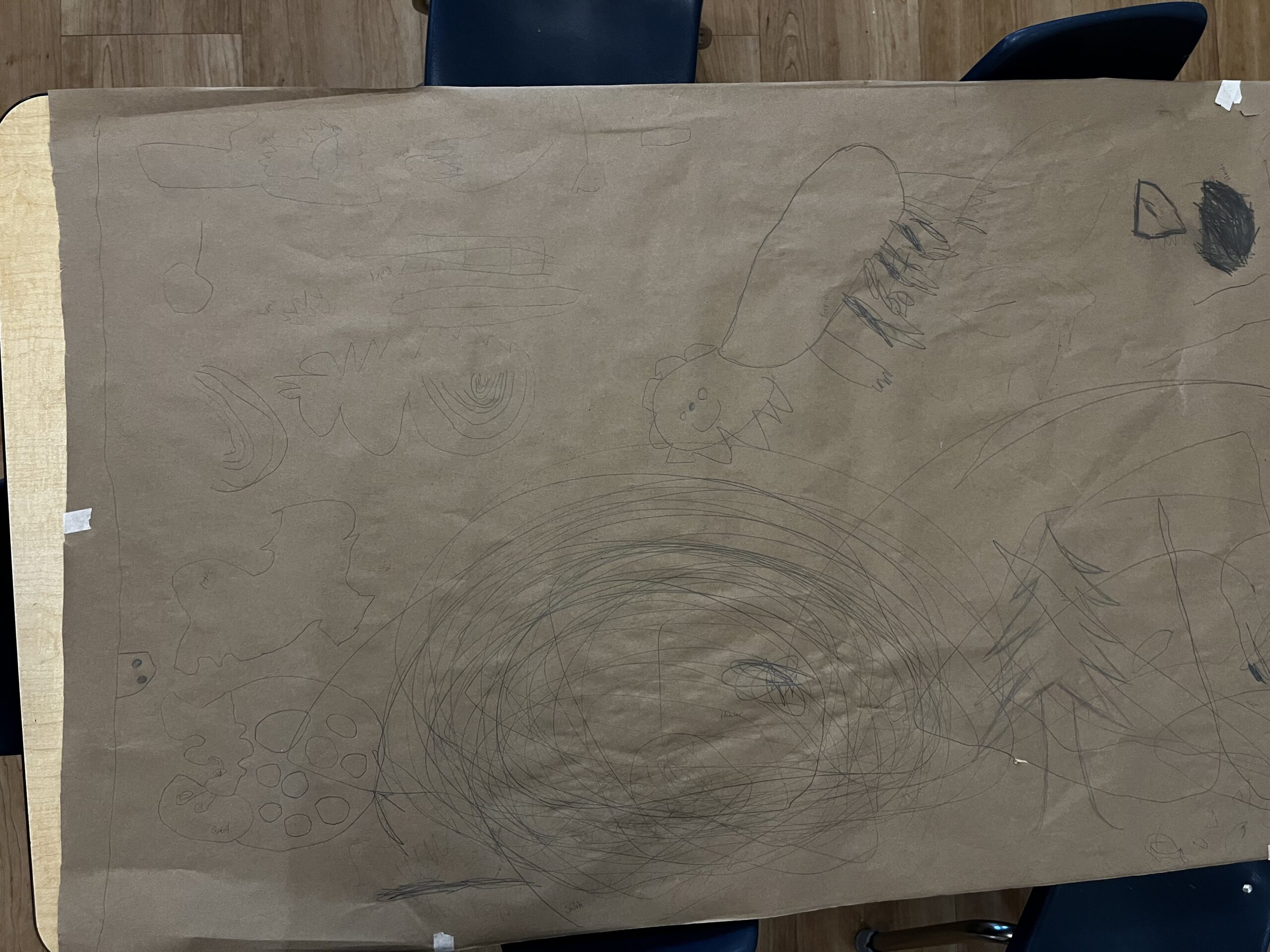
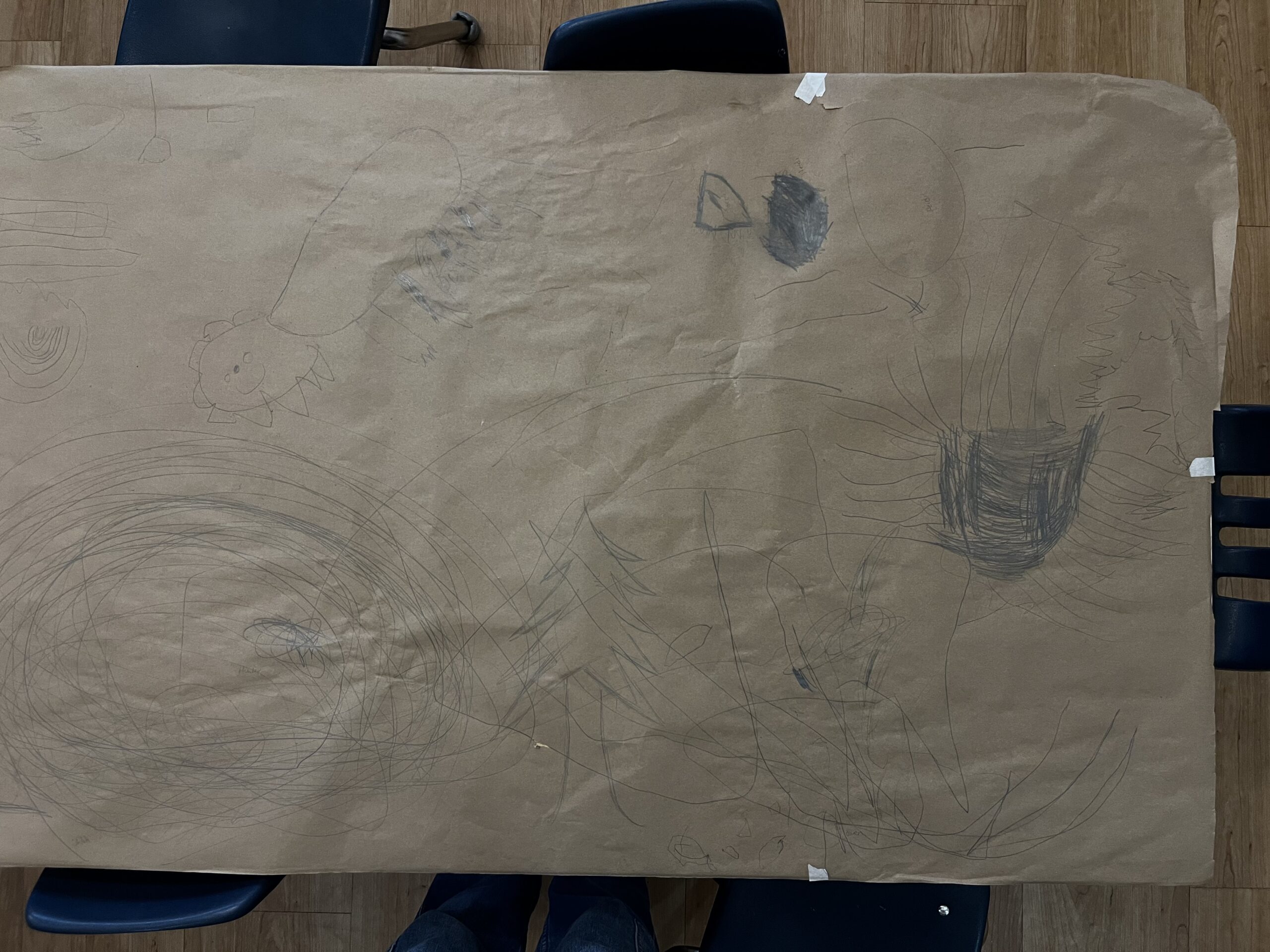
Later that day, during the drawing ritual I had created, I came with the intention of seeing what the children had seen on our walk earlier in the day. I asked them to draw what they saw when we walked up into the hills, to a field where the children were able to run freely about. I wanted to invoke some deeper thinking by remembering specific things that they saw earlier that day. Some children drew rocks, as another teacher had asked the children to find a rock to bring back to the classroom for a different project. Some drew mountains, a few drew some flowers, and a rainbow. One child drew a spider, and two children drew something a bit more interesting: a hot air balloon and a lion.
HOT AIR BALLOON
Educator: What’s this one?
S: A hot balloon.
Educator: A what? Sorry?
S: A hot balloon?
Educator: You saw a hot balloon today?! What colour was it?
S: Pink!
Educator: Pink? Did it have people on it?
S: Yeah.
Educator: Yeah? How many?
S: cups hands together
Educator: A few?
S: nods head
Educator: Yeah. Do you know how hot air balloons work?
S: shakes head
Educator: No?
F: There’s fire, and it blows it up!
Educator: Yeah! The fire creates hot air that inflates
the balloon part and makes it float.
DRAWING RITUAL
Educator: Did he have big eyes?
T: Only these eyes
Educator: Only these ones. Did he roar at you?
T: No, he likes me
Educator: He likes you? Oh, okay, does that mean he hangs out with you?
T: He was smiling to me.
Educator: He was smiling at you?
T: He has lots of feet
Educator: He has lots of legs. How many legs does he have?
T: Fifteen!
Educator: Fifteen! What colour is this lion?
T: Um, it’s a normal one that it was.
Educator: The normal colour? The yellow gold colour?
T: Yeah
Educator: Did the lion tell you his name?
T: He roared out his name, and he said “Reeh” like his name was Reeh
Educator: Reeh? That’s a cool name.
*new day*
T: This is the lion that I saw
Educator: Oh, you’re going to draw your lion again? I definitely want to see your lion again. Are you going to draw his fifteen legs?
T: Yeah. This one has a broken leg.
Educator: That’s unfortunate. How did he break his leg?
T: He didn’t actually broke his leg, I’m just pretending.
Educator: Are you done with your drawing?
T: Yeah.
Educator: Is there anything different about him this time?
T: No.
Educator: Did you see him again today?
T: Yeah.
Educator: Was he outside?
T: Yes.
Educator: Yeah
T: He followed me when I went outside. He can go in walls. He’s in the wall right now.
Educator: He’s in the wall right now?
T: He’s in the wall.
Educator: Is he invisible then?
T: Yeah.
Educator: So we can’t see him, only you can?
T: Yep. I can see when he’s invisible.
Educator: Yeah? Does he still not like H’s head?
T: *shakes head*
Educator: Yeah, no? Doesn’t like him still?
T: He doesn’t like anybody; he only likes me.
Educator: So, he only shows himself to you?
T: Yeah.
Educator: He only likes you?
T: Yeah.
Educator: I wish I could see him. That would be really cool.
This conversation makes me think that this child is making himself a new friend when in a different environment that doesn’t have toys or activities like the gated outdoor play area. The child is having a conversation through his drawing while also putting his imagination onto the paper; he is visualizing his friend. The image of the child here is more obedient, complacent, and “inside the box”.
I came back a few days later with the same paper but a new material to draw with: black markers. I asked the children to create new drawings on top of the pencil drawings from the previous week. I intended to see if the children would create something new or if they would go over the pencil lines and build on what was previously created. I wanted the children to think deeply about their drawings and to see what thoughts had formed with the new and old drawings on the collective paper. One child who had previously drawn with the pencils came over and re-drew his previous drawing, as other children who hadn’t previously drawn on the paper came over and made new creations and stories.
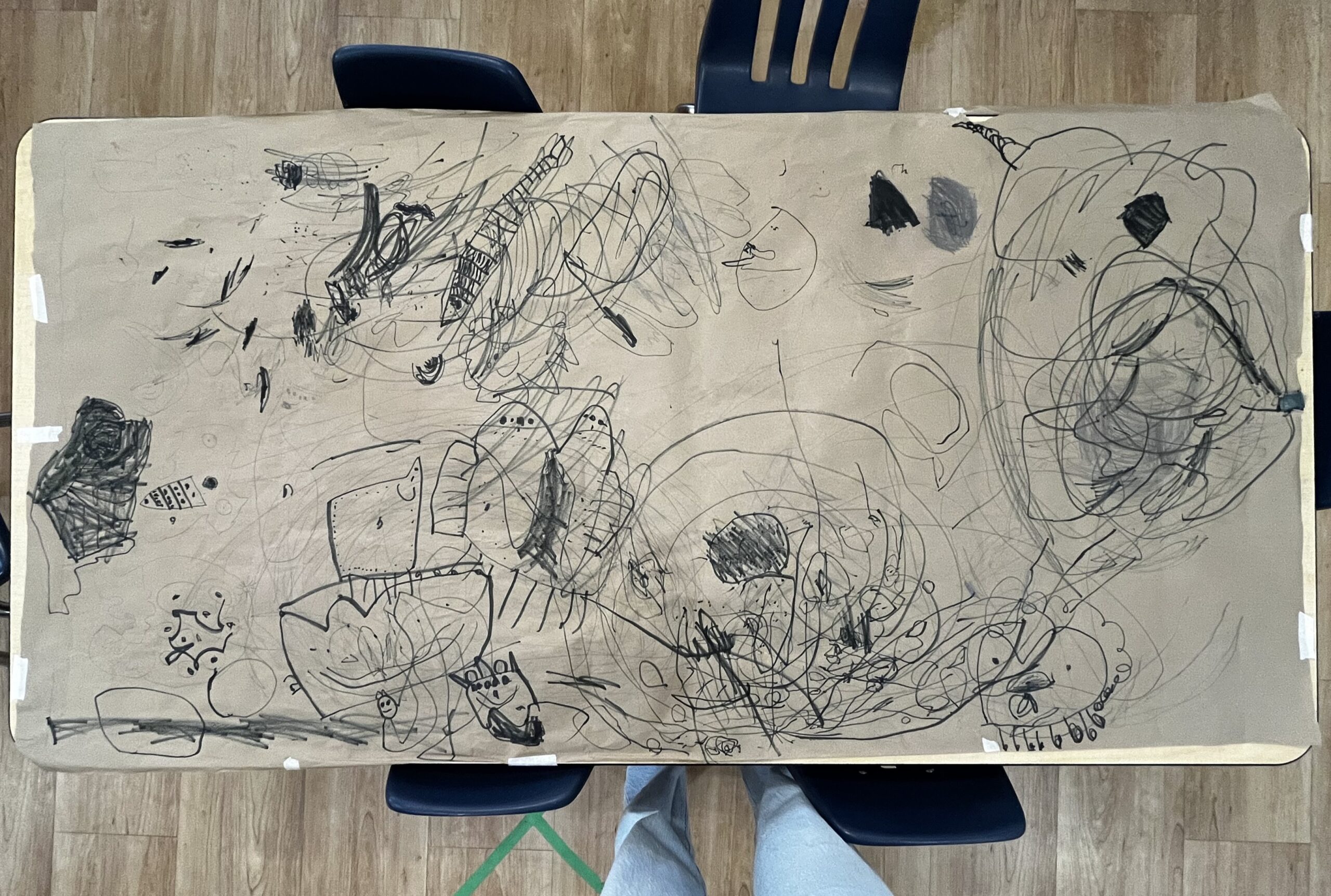
Educator: With his 15 legs, how does he get around? Does he move?
T: Yes
Educator: How does he move?
T: like this arms wide and he just runs, he runs.
Educator: With all 15 legs?
T: Yeah
Educator: Does he have some on one side and some on the other side?
T: Yeah.
Educator: Or maybe does he have some legs in the middle?
T: he has two on this side and… four on the other side
Educator: On the other side? okay. And he has more legs we can’t see?
T: Yes has lots of legs
Educator: Can his legs do anything other than run?
T: Yeah
Educator: What can they do?
T: They can do a backflip
Educator: A backflip?! How did he learn how to do a backflip?
T: cause he’s a teenager
Educator: Oh, he’s a teenager? Oh, okay, so he’s older than you.
Mentor-Educator: Did you hear that T’s lion can do a backflip? What would that even look like?
Educator: Do you think you can draw the lion doing a backflip?
Mentor-Educator: Whoa, do you think you could? How would it look? Do you wanna try it out?
pause
Mentor-Educator: Can you draw the lion doing a backflip?
T: he can’t… he can’t move.
Mentor-Educator: This lion can’t move?
T: he can’t move on this paper.
Mentor-Educator: Oh, he can’t move on this paper… hmm. I’m gonna write that down. The lion can move, but he can’t move on this paper. So the lion, it’s hard to draw a backflip cause he says the lion can move, but he can’t move on this paper.
Educator: Oh, so you said he went into the walls the other day. How does he go into the walls?
T: um.. he’s really strong.
Educator: So, can he get off the paper onto the walls?
T: No!
Educator: No?
T: Paper can’t move
Educator: It can’t?
T: Yeah.
Educator: Are you sure?
A: Yes, it can! moves paper with hand back and forth
Mentor-Educator: Wait… Oh! This paper is moving.
Educator: Yeah!
T: No! She’s holding it
Educator: But the paper is still moving. So is this the lion or just a drawing of the lion?
T: Um, this is just a drawing
Educator: Just a drawing, okay.
Mentor-Educator: A drawing of a lion that you saw? In the walls?
Educator: You originally saw him in the field, right?
T: nods head
Educator: And then he came to the classroom with you? And he was in the walls?
T: nods head again
Educator: Okay, just making sure we got it all right.
A: I’m making a crown monster. Crown monster!
Mentor-Educator: Crown monster… we’ve got a crown monster over here. Have you ever heard of a crown monster?
T: Nope
Mentor-Educator: What is a crown monster? What’s the story of a crown monster?
T: I thought that it was a queen bee.
Mentor-Educator: Oh, was it a queen bee last time? Oh, it’s turned into a crown monster, it sounds like.
Educator: Do you think the crown monster and lion could be friends?
A: Maybe!
T: No
Educator: Lions not allowed to have any other friends?
A: Yes, he is!
Mentor-Educator: But that’s what T is saying
Educator: T’s saying he’s not allowed any other friends
T: he can have more, but I get to control him, I… I.. I control him right now.
Mentor-Educator: You’re controlling him? I’m curious about why you control him not to having other friends?
T: I can help him make more friends
Mentor-Educator: So you can say no friends, and you can say lots of friends?
T: nods
Educator: Is he your pet lion then?
T: Yes
Educator: Does he come home with you
T: Yep
Mentor-Educator: Hey, it looks like whatever X’s is making is getting closer to your crown monster. What I see in her story is lots of lines and dots. I’m going to make some lines like X.
T: Why are you making lines?
Mentor-Educator: cause X showed me how. She’s also got some dots on hers. I’m going to put some dots all the way onto the crown monster.
A: I already got dots on my crown monster
Educator: I see. What are the dots on the crown monster? Can you tell me what they are?
A: They’re the eyes
Educator: Oh, how many eyes does it have?
A: one two three four five six seven eight nine ten eleven twelve thirteen fourteen fifteen seventeen eighteen nineteen!
Educator: Nineteen eyes?
Mentor-Educator: Have you ever seen a creature with nineteen eyes before?
A: Yeah!
Educator: Yeah? Is it the crown monster?
A: Yes!
Educator: Yeah? Where did you see him?
A: The shop
Educator: The shop? What shop?
A: Um, at the crown shop. There was a crown monster there.
Educator: What was the crown monster doing?
A It was… It was trying to look for food.
Educator: Well, what does it eat?
A: Chicken noodles.
Mentor-Educator: When someone with nineteen eyes, how does they see?
A: They colour!
Mentor-Educator: they can see colours? Is that what you mean?
A: They see things on the ground that’s got left behind.
Mentor-Educator: Did you hear that T? That a crown monster with 19 eyes can see things that were left behind by other people. So what you’re saying is that a crown monster with 19 eyes can see things that got left behind on the ground by other people. What do you think about that idea?
T: It’s weird.
Mentor-Educator: Weird? I think it’s a little weird, too.
*inaudible*
Mentor-Educator: Oh, it can see more good because it’s got so many eyes, is that what you said?
T: No, you can put stuff in their eyes that makes them, help them see more good.
Mentor-Educator: Did you hear that A? T had the idea that you can put things inside the eyes to make them see more good?
Educator: What are you thinking of putting in the eyes to make them see better?
A: Jewels!
This conversation isn’t over, but I wanted to pause and take a look at what is happening here. A is being creative and intentional with her drawing. She is giving her drawing a story, a background, and details. T is chiming in, being more intentional with his drawing and giving his friend more details. He is deepening this thought process and getting more creative as he goes. My Mentor-Educator was also here during this time and asked some very thought-provoking questions that got the children building their stories and telling them as they kept drawing. The image of the child here is capable, creative, intentional, and curious. They also show their they have language skills through their storytelling. This has changed since the first few collaborative drawings that I have some in this classroom over the past few weeks. I am also giving them the conditions for the type of deep, creative thinking that they are doing here to show them that they are capable, competent, and coming with knowledge. These children are challenging the image of the child from the previous week, as well as within the conditions and environment of their classroom. They continued their drawings collectively and started to converse more with each other about their drawings. The story kept building between the two children about the different monsters and things they had drawn.
Educator: Is there anything else you can think of?
A: This is a square monster
Educator: Square monster?
Mentor-Educator: a crown monster and a square monster? With one eye?
A: No, the other eyes are over here
Mentor-Educator: Oh, I see
Educator: So, it can see you on the side of him?
A: Yep
Educator: Why don’t you draw a monster T?
T: When I drawed something, I sometimes mess up.
Educator: That’s okay
T: Okay, I’ll draw it
A: You can draw it at the inaudible
Educator: Yeah, that’s true. There’s a lot of paper we can use
Mentor-Educator: I’m gonna turn this one. Maybe we can turn this one into a monster somehow.
T: What is that, a snail?
Mentor-Educator: I don’t think so. I think that S made a hot air balloon.
A: hot air balloon
Mentor-Educator: Yes, but I think it might be turning into a monster today. Look at all those eyes. I’m going to make these ones some eyes.
A: That… that one is just an owl
Mentor-Educator: Oh, do you want to sit in my spot and make him into an owl?
inaudible
Educator: Do you like eyes?
Mentor-Educator: Should we draw a force field around this?
Educator: What makes eyes so interesting to you?
A: Makes us to see.
Educator: That’s it? Just makes us see. Is that all eyes do?
A: Yes.
Educator: There’s nothing else that the eyes do?
A: No!
Educator: What about moving? Can they move?
A;Yeah
Educator: Can they blink?
A: They can!
Educator: Yeah! What else can eyes do?
inaudible
Mentor-Educator: Okay. That’s a stomach you said? A big stomach, you said?
A: Yeah
Mentor-Educator: Yeah? Does he eat a lot of food?
A: Yeah.
Mentor-Educator: What kind of food does he eat?
A: Chips, and snails, and people!
Educator: Oh no! Does that mean we have to run and hide when we see him?
A: nods He eats toys.
Educator: Why does he eat people?
A: Cause he just likes to eat people and… and… he eats glasses that are left behind!
Educator: Well, I can’t leave my glasses behind. Then I can’t see!
Mentor-Educator: How does that crown monster know the square monster?
A: Cause the square monster is named Ticks.
Mentor-Educator: The square monster is named six?
A: No, Ticks!
Mentor-Educator: Ticks, and that’s how they know each other?
A: Yeah
Mentor-Educator: How did they meet?
A: They met at the shop over here.
Mentor-Educator: Oh, when they were getting chips? Got it, they both like to eat the same things.
A: Yep
Mentor-Educator: How do they know the balloon monster?
A: They don’t know the balloon monster.
Mentor-Educator: Interesting.
A: They don’t know the balloon monster’s name.
Mentor-Educator: So they don’t know his name?
A: No.
Mentor-Educator: So, they’ve never met before? They’ve never been introduced?
A: Now he has bigger eyes!
T: No, those are spots.
Mentor-Educator: Spots or eyes? That’s a good question. A sees eyes, and T sees spots.
T: What are you doing?
A: I’m giving them scatters.
Educator: Ooh, connecting the eyes. What made you want to connect the eyes?
A: Cause, so they can get close to each other. So they can get close.
Educator: What do you think of that T? What do you think about drawing the lines to make the eyes closer?
T: That looks really weird. Those look like spider webs attached.
Mentor-Educator: Ooh, I’m gonna draw the spider that made them. This spider lives on this monster and makes a connection between its eyes.
A: I made that.
Mentor-Educator: We made it together.
A: Dot, dot, dot, dot, dot.
Mentor-Educator: Now, are these dots or eyes on the crown monster?
A: Dots!
Educator: So the eyes are up top, and the dots are down below?
A: Yeah!
Mentor-Educator: And these eyes on the square monster are everywhere, all around. These are all eyes?
A: No, now they are buttons.
Educator: Now they’re buttons?
A: Yeah.
Mentor-Educator: They changed from eyes to buttons; that happens sometimes.
T: What is this little dot?
A: It’s an eye.
Mentor-Educator: That’s an eye.
T: He only has one eye?
Mentor-Educator: Just one. The eyes are interesting.
A: This guy has one, two, three, four, five, six. Got eyes.
T: One, two, three, four, five, six. Oh yeah, six.
Educator: Do all monsters have eyes?
A: Yeah.
T: No.
inaudible
A: This guy has three mouths
Educator: Does he have three stomachs then?
A: No.
Educator: No. Yeah, he has one. I only have one.
A: These are earrings.
Mentor-Educator: Do all monsters have eyes, but also do with their eyes, maybe they can see different things because they all have different kinds of eyes. I’m thinking about… I’m thinking about flies.
A: Earrings.
Mentor-Educator: Oh, yeah, earrings.
A: Earrings.
Mentor-Educator: I’m gonna draw triangles like my earrings.
Educator: T, if not all monsters have eyes, how do monsters see without eyes?
T: they. They have a little protection, like a little majiggy thing.
Mentor-Educator: A little majiggy.
Educator: A majiggy?
T: Yeah. And then they help. And then that protects and helps them see.
Mentor-Educator: Oh, that’s pretty cool.
Educator: Interesting.
Mentor-Educator: Can you draw a majiggy on this monster?
T: Okay.
Educator: On that. Yeah.
T: Has a little backpack.
Mentor-Educator: It’s a little backpack?
T: And then it has eyes on the back.
Educator: The majiggy has eyes, too.
T: Yeah. So. And then the eyes. And there’s a little string that can goes in the monster’s body.
Educator: Okay.
T: And, like, this goes in his body, and then the eyeball comes back in his eyes.
Educator: Oh, okay. So these eyes go through that and come out onto the monster, and then he can see.
T: Yeah.
T: Put it on the monster.
A: I’m making a cover for the monster.
Educator: Why do you want to cover the monsters?
A: Because I don’t want them to get discarded.
Educator: Who’s gonna hurt them?
A: This thing.
Educator: But that’s a majiggy. A majiggy is supposed to help monsters.
A: They eat monsters.
Mentor-Educator: The majiggies eat monsters?
T: No, they don’t.
Mentor-Educator: Are you sure? Maybe they only eat square monsters and crown monsters. And you don’t know because you made an owl monster and a giant leaf, or a lion monster.
A: Had a lot of this one and this one and this one.
Mentor-Educator: So majiggy is-
T: This is not a monster.
Mentor-Educator: Oh, that’s.
Educator: That’s your lion.
T: Yeah.
Mentor-Educator: Excuse me. I made a mistake. I thought it was all monsters, but that was from last time.
A: Now I’m making covers.
T: I drawed that last time.
Mentor-Educator: So, T, the majiggy seems like a good thing for this monster because it means he can see. But the majiggy is not such a great thing for these monsters because the majiggy is it the majiggy that makes this monster monster eat these ones?
T: No, no. The majiggy-
*A goes to interrupt*
Mentor-Educator: Wait, wait. Wait a minute. Listen. Wait.
T: The majiggy steals their eyes, and then it sucks in the, there’s more eyes. And if they lost the other eyes, they get more.
Mentor-Educator: Well, did you hear T’s idea? Did you hear it? And then we want to hear what you have to think, A, because he said they steal, T says the majiggy steals the eyes,
T: So. So he can get more eyes.
Mentor-Educator: He’s working together.
T: Yeah.
Mentor-Educator: Oh, man. What’s your idea, A? I know, it’s so hard to wait.
A: But the majiggy eats the monsters, though.
T: They don’t. No, they don’t.
Mentor-Educator: Steals the eyes or eats the monsters?
Mentor-Educator: That’s a big. That’s a disagreement.
T: Well, they do at the same time.
Educator: They do at the same time. Majiggy is very powerful for such a small thing, isn’t it?
Mentor-Educator: I’m gonna, I’m gonna write down our problem.
A: A little Majiggy gets. Eats the monsters. Eats the big monsters. And then it gets very big.
Mentor-Educator: The Majiggy steals the eyes.
A: The Majiggy is
super small. And then when the
monsters are big, and a majiggy is small, the majiggy eats the monsters.
T: Why the Majiggy gets bigger?
*audio cut out*
Educator: Okay. You said your lion was a
fire lion.
T: Yeah.
Educator: I thought you said he was a normal one. He’s a normal fire lion?
T: Yeah.
Educator: What’s a normal fire lion?
T: He can shoot fire out
of his mouth once.
Educator: He shoots fire out of his mouth? What is that?
T: He shoots at animals because that’s how he fights with them.
Educator: Oh, he fights with them? Does he fight a lot?
T: What
Educator: Does he have to fight a lot?
T: Yeah.
Educator: Yeah. Why does he have to fight a lot?
T: Now there’s monsters.
A: Cuz this is a monster. This is big. And he didn’t. And he… inaudible
T: I saw he was fighting with someone.
Educator: Wow.
T: He’s fighting with the stuff.
Educator: What do you think a fight between a fire lion and a skunk would look like?
T: Fire lion is more yellow and *inaudible*
Educator: Oh, okay.
A: Asparagus… This asparagus. This asparagus monster eats flies. Asparagus…
Educator: Asparagus?
A: It’s asparagus monster.
Educator: Asparagus monster.
A: It’s made out. It shoots water out of its mouth. It shoots water out of it.
Educator: And it’s an asparagus?
A: Yeah. It keeps water out of his mouth.
Educator: Where did you come up with that idea?
A: I just made it.
Educator: You just made it?
T: Oh, there’s. There’s someone still asleep.
Educator: That’s okay.
A: Okay, there’s one right now.
Educator: Oo, so T, what else can you tell me about your lion?
T: Don’t fall with that one.
Educator: What’s that? Oh, you made
stripes in his mouth.
A: Yeah.
T: Maybe that could be his trunk.
A: That’s black bubble gum.
Educator: So, T, what else can you tell me about your fire lion?
T: He can do this. He can turn on when the lights are too high for him. He just jumps really high and just turns it on.
Educator: Turns it on or turns it off?
T: Both.
Educator: Yeah, he can do both?
T: Yeah.
Educator: Do you know… Have you seen those lights where you clap and they turn on and off?
T: I watched that in a movie.
Educator: In a movie. Is it similar to that?
T: Yeah.
Educator: Where he just has to do something very simple, and the lights turn off. He just jumps and the lights turn off?
T: No, he just does a backflip, and then it just comes on.
Educator: Oh, so his backflip is what turns it on. So that’s why he backflips a lot, okay.
A: What turns it off? T
T: He does the same thing backflip.
Educator: Oh
A: Yeah?
A: Yeah.
Educator: Oh, and now there’s dots in there.
A: Yeah.
T: Maybe that’s a bubble gum.
A: Now there’s. Now there’s just. Just. Now there’s seven monsters.
Educator: Seven?
A: Yeah.
Educator: Wow, that’s so many monsters.
A: One, two, three, four, five, six. Wait. One, two.
Educator: This one.
A: Oh.
Educator: This one.
A: One, two, three, four, five, six, seven.
Educator: Definitely seven. Oh, no, we forgot the asparagus monster. That one’s eight.
A: Eight?
Educator: Yeah, there’s eight.
A: I already did that one.
Educator: No, we counted them. We counted the Magiggy, not the asparagus monster.
A: One, two, three, four, five.
Educator: Oh, maybe we’ll leave the lion alone. I think the lion should be left alone. Unless T wants to do anything else to him. Let’s leave the lion alone.
A: I’m making another. I’m making a friend.
Educator: You make a friend beside him. There you go.
T: I made my tiger.
Educator: It’s a lion, isn’t it?
T: I’m making my lion. I’m controlling him now. He’s your friend. I controlled him.
Educator: Oh, that’s good.
A: Shark.
Educator: He’s a shark.
T: I’ll show how the fin goes. Okay.
Educator: Yeah. There are two fins, right?
T: And then for like. Oh, I can make good.
Educator: Oh, thank you for doing that, T. So is the shark going to be
friends with the lion?
A: Yes, it’s a nice shark. It’s a nice shark.
Educator: She said it’s a night
shark.
T: This one’s bad. But it’s
nice to people.
Educator: Nice to people. Well, she said it’s a nice shark, so why can’t the lion shark be friends?
A: It says stripe shark.
Educator: Striped shark. Have you seen a striped shark in your life?
It’s a nice striped shark.
Educator: Have you seen any kind of sharks in real life?
T: No.
A: A nice shark.
Educator: Yeah.
T: Only a fish.
A: It’s a nice. It’s a nice striped shark. Okay.
A: I need this pencil. I do eyelashes.
T: I’ll actually start. Is that a girl?
A: Yeah, it’s a girl shark.
Educator: Yeah?
A: It’s a nice girl shark.
Educator: Where did the shark come from? What made you think of a shark?
A: It came from here.
Educator: What’s here?
T: That’s the river.
Educator: That’s the river?
T: I’ll draw the river.
Educator: You’ll draw the river? Do sharks live in rivers?
T: Yes, they live in.
A: The rivers are straight, like this.
Educator: So that could be the lake at the end of the river or in the middle of the river.
The one child began using his imagination and creativity more when collaborating with another classmate who was drawing and demonstrating their own creativity. The lion was a “normal” lion with fifteen legs during the first drawing, but has turned into a backflipping fire lion as the drawings have gone on throughout the few weeks that I have been with the children. It’s enriching to see the difference in the drawings as time goes on, and I am looking forward to adding colour to this project.
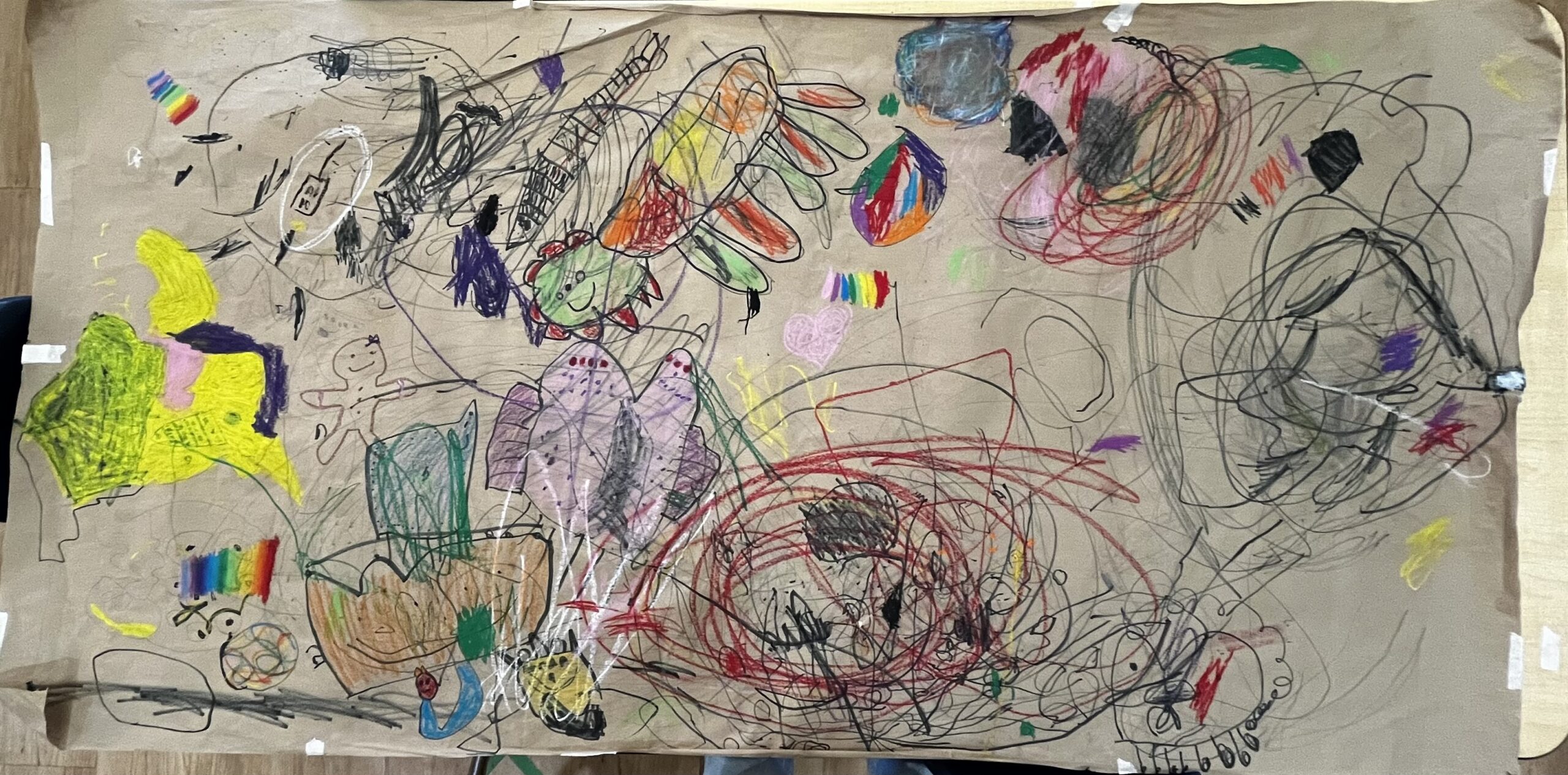
T: My lion’s still there.
Educator: So if you color him in, it’ll be okay, right? See? There you go.
T: Lions are supposed to be this color. But someone just scribbled in mine. But I’m. But that’s okay.
Educator: That’s okay, yeah.
T: This is a shark,
Educator: Right, that’s the shark. What’s the shark do again? The shark is friends with the lion, right?
T: Yeah, yeah. No, he’s not.
Educator: I thought he was.
T: No, no, he’s not. He’s not.
Educator: But isn’t he a nice shark?
T: Yeah, he is nicer. He [the lion] doesn’t like sharks, but. But Avery isn’t gonna decide the shark is his friend. Cause it’s my shark.
Educator: Okay.
T: This one, this one. This one is a little bit poisonous.
Educator: Oh, it’s poisonous now?
T: But I can ride on it.
Educator: So it’s a poisonous fire lion now?
T: Yeah, I can. And I can ride on it. I can ride on it.
Educator: Oh, okay.
T: I can ride on it, and it’s poisonous.
Educator: Poisonous? So the green represents that these are poisonous.
T: Yeah.
Educator: So what is, what is that something new?
T: No, it’s a fire lion and a poisonous one. Red isn’t poisonous, and his body is not poisonous. And the legs are half poisonous, half fire.
Educator: What do you call it?
T: B just coloured on my lion.
L: It’s okay, T. You can still colour it.
T: B just coloured some purple on my lion.
Educator: That’s okay, you can just have a bit of purple on it, right?
T: No.
Educator: It could be part of the poison. Yeah, you just got to make it part of the story. Cuz see, when we. When we draw it all together, things like this might happen. So we got to be able to join together.
Educator: So the green legs. What are the green legs?
T: Poisonous, poisonous ones.
Educator: And then the red legs?
T: Are the fire legs.
Educator: Okay.
T: This is for the fire.
Educator: Yeah.
T: Yes.
Educator: Okay. Is there anything new about him other than the poison?
T: Oh, I forgot something.
*new day*
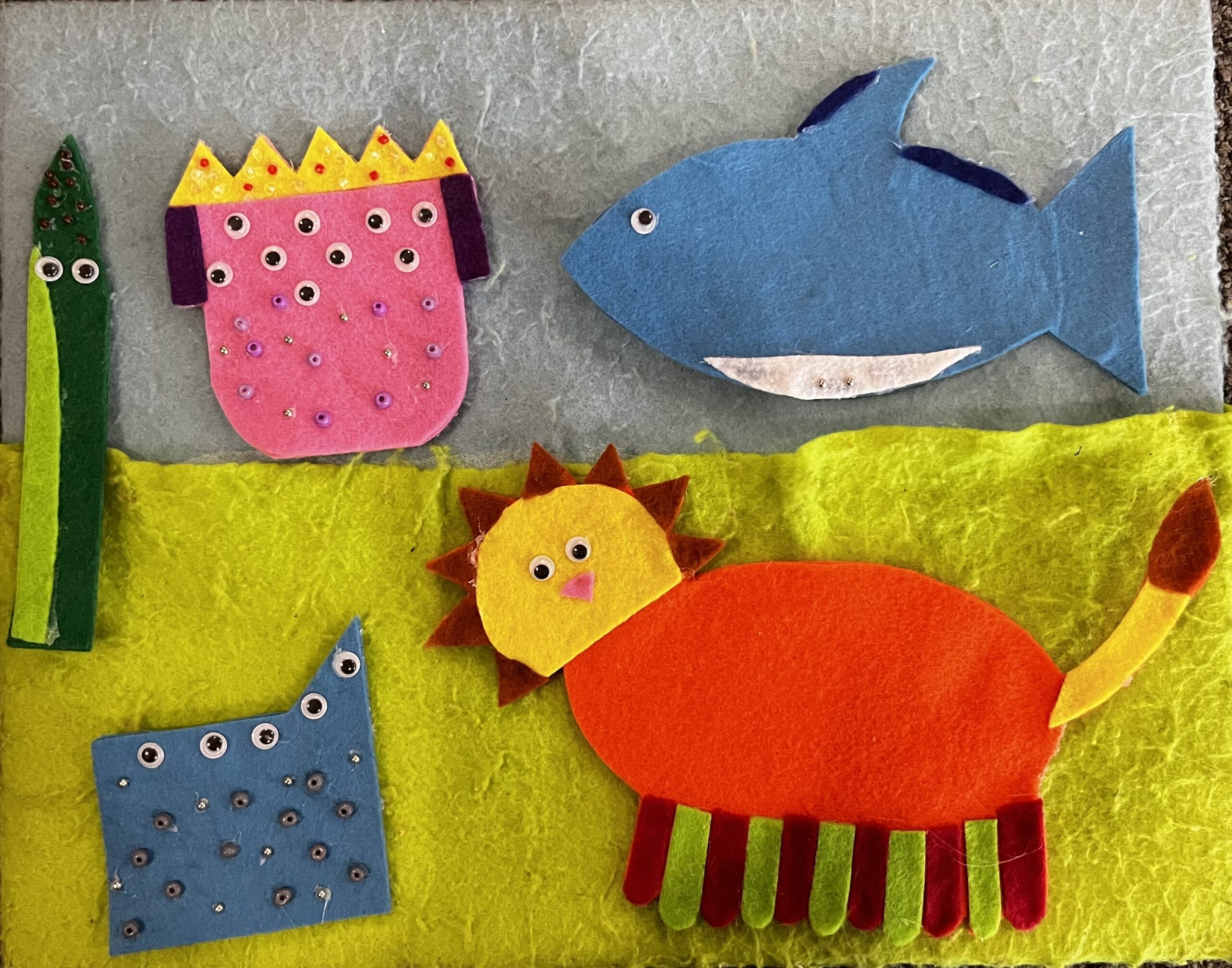
I created felt characters from the drawings the children made during our drawing sessions. I wanted to leave these with the class so that the children can share their creations and stories with other classmates. T and A specifically liked them and ended up showing them to other classmates. After showing other classmates, A went to the drawing table, where another teacher had brought out a new, large sheet of paper, and showed her friends what a crown monster was. Other children then joined and began drawing their own creations of crown monsters. They began a conversation about what a crown monster looked like and how many points its crown had. A says they only have three points on their crown, so the other children’s monsters weren’t crown monsters because they had more than three points on their crown.
My goal within this project was to see what the children can do with their own creativity and imagination. This has shown me that creativity and imagination can be individual and collective. Children can influence others by what they do and share, including creativity. This project began with one child and one character, but evolved into multiple characters among various children. They were able to work in the conditions I created, and they were able to use those conditions to take their time to think about what they were doing. I wanted the children to have intention for their drawing. All drawings have meaning, but I wanted to create the conditions for the children to think deeply and have intention about their drawing and the stories they come up with while creating their drawing. I made the felt story to show the children that their creation can become a story for them to share with others. Their creations and their stories are important.
I am continuously amazed by children and what they bring, and am thankful to have been able to share these moments with the children I created relationships with.